The Engineering Behind Award-Winning mmWave Radar

Written by Sophie Struckmeyer
Marketing Executive
From award-winning innovation to future possibilities: the story behind PLX-T60 mmWave Radar
The Engineering Behind Award-Winning mmWave Radar
The King’s Award for Enterprise: Innovation recognises the engineering behind PLX-T60, Plextek’s high-sensitivity millimetre-wave (mmWave) radar technology platform. Developed to overcome the limitations of highly integrated radar-on-chip devices, PLX-T60 has since enabled applications ranging from infrastructure monitoring to sensing in space.
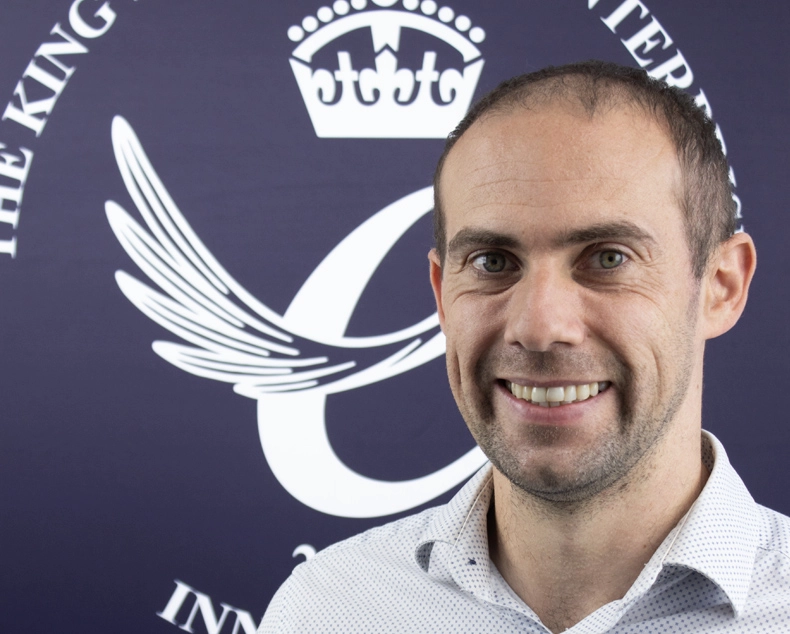
The award is only part of the story. Dr James Henderson, who led the development of PLX-T60, has spent more than ten years working on complex radar problems and was awarded an EngD for his research on reconfigurable mmWave antenna systems. We spoke with James about how the technology evolved and where high-sensitivity radar could go next.
Improving mmWave radar sensitivity
In 2018, Texas Instruments released the IWR6843 [Link: https://www.ti.com/product/IWR6843], an industrial-grade radar-on-chip device. It is a highly integrated, single-chip mmWave radar: a compact, low-cost way to build short-range radar that is significantly smaller than traditional systems. The device fits an entire radar system onto one piece of silicon. But this design came with limitations.
“The chip is doing all of the radar functions, from a hardware and processing perspective,” explains Plextek’s Dr James Henderson. “It is doing everything on a single piece of silicon, which is amazing, but there are inherent limitations, particularly with respect to its sensitivity.” James and the Plextek team were already experimenting with ways to improve mmWave radar sensitivity, and knew they could get more out of the Texas Instruments chip. They began using it in their experiments and wanted to address the limitations of its integrated architecture. The chip has a high receiver noise figure of 12 dB, its power amplifiers produce just 20 mW, and the memory available for data processing is limited for some applications. Furthermore, the reference antenna solution is not sufficiently wideband for many applications.
Whilst the chip is well suited to some applications, the team saw an opportunity to extend its capabilities. Improving sensitivity, precision and RF performance could open the technology to a much wider range of applications.
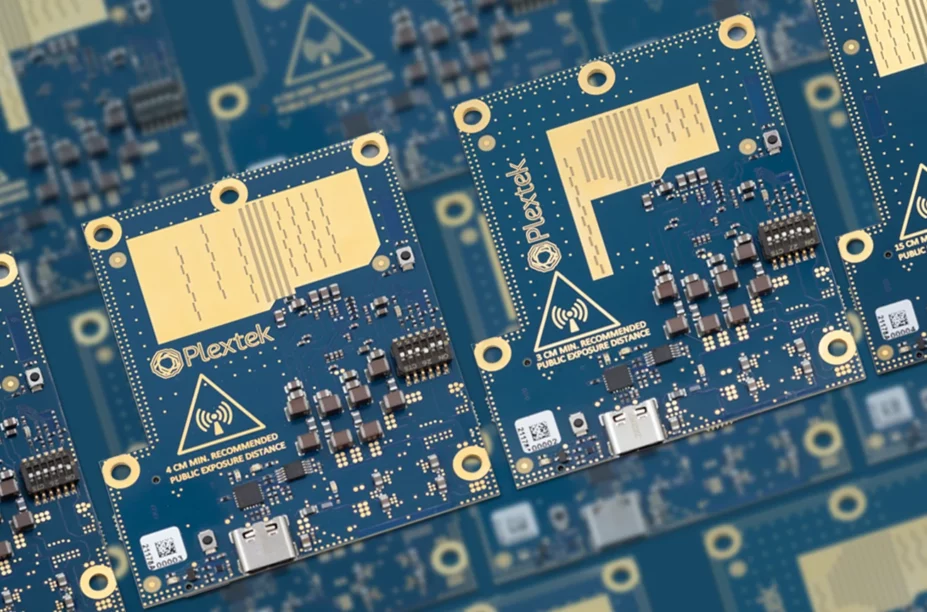
Two areas were identified that offered the greatest benefit to sensitivity: the antenna solution provided with the evaluation board, and the radar-on-chip’s receiver noise figure. To overcome the chip’s inherently limited noise figure, the team added low-noise amplification to the receiver using a compact, low-cost method. This was combined with a novel, patent-pending antenna design that achieves high efficiency over a wide bandwidth.
“We get about a 24 dB improvement in sensitivity,” says James, “which translates to a 4x improvement in detection range, ignoring atmospheric losses which can be high in the 60 GHz band.”
Improving RF sensing for new radar applications
Different applications require different radar performance. Operating frequency, antenna characteristics, processing, available power, physical size and the required detection performance all impose constraints on the system.
The improvements behind PLX-T60 combine better antennas, integrated amplification, and improved software and data-processing algorithms, each tailored to the constraints of a specific application. The Plextek team continue to develop the technology across the whole radar chain, including the new antenna approach and software developed in-house.
“With radar, you need to optimise for the specific application,” says James. “Particularly with a small, lightweight radar solution, you’re really constrained with radar hardware and processing resources.”
Beyond being a more sensitive implementation of the TI chip, the work became a configurable radar platform that could be adapted to different requirements. The first identified applications demonstrated just how broad those requirements could be – from fixed monitoring for traffic management to airborne infrastructure surveillance and inspection, and before long the team were applying it in new, more demanding environments.

PLX-T60 radar technology for space applications
“One of the initial applications was mounting it to a drone and using it to detect obstacles like power lines,” says James, “and then we were sending the radar to space.”
The heightened sensitivity that the PLX-T60 offered for remote sensing created a unique opportunity for space applications, notably the challenges of managing microdebris in Low Earth Orbit. Space debris represents a critical infrastructure risk that is becoming more acute with the launch of satellite mega constellations.
For spacecraft operators, the consequences of small objects travelling at orbital velocities are significant. Even very small particles can carry enough kinetic energy to damage craft, equivalent to the energy carried by a bullet at ground-level.
ESA (European Space Agency) estimates 230M untracked micro-debris pieces in orbit. While large objects such as satellites and bigger debris can be detected and tracked from earth using long-range radar systems, small (mm-sized) objects are difficult to detect. Accurately modelling the debris population is critical to the safety of future space missions.
Why is high-sensitivity sensing important in space?
As James notes, “High-sensitivity sensing is crucial to validating debris models, so that we can get a better picture of how much debris is actually in space.”
As better measurements improve models of the space environment, our understanding of how small debris populations develop will improve.
At the time of writing, four Plextek-designed mmWave radars based on a similar architecture to PLX-T60 have been deployed across two missions, aimed at understanding the challenges posed by the growing amount of micro-debris in LEO.
The Adler missions were funded by the Austrian Space Forum (OeWF), and Plextek worked with spacecraft integrator Spire Global to develop the in-orbit micro-debris mmWave radar sensor.
Partnership with ClearSpace
ClearSpace is an in-orbit servicing company that builds spacecraft to inspect satellites, extend their operating lives, and remove them or other debris from orbit. ClearSpace partnered with Plextek to deliver these capabilities which support the sustainable use of space, from refuelling operations to debris management. The level of sensing detail provided by Plextek’s mmWave radar enables safe, precise proximity operations that debris removal and in-orbit servicing depend on (read more about the partnership here ClearSpace and Plextek: Pioneering Advanced In-Orbit Servicing).
Valentin Valhondo, Technical Program Manager at ClearSpace, says: “We chose Plextek due to their proven technical expertise. Their radar systems are instrumental for achieving the paramount need for safety and precision in proximity operations.”
The partnership shows that, alongside the strength of Plextek’s underlying mmWave technology, much of the platform’s value lies in its configurability for demanding real-world applications.
The development cycle was itself an engineering achievement. For the radar, the system went from concept to launch in around nine months. Adapting existing platforms and capabilities to the specific application made a faster route to launch possible.
Future PLX-T60 applications in defence and security
The qualities that make PLX-T60 suited to space (high sensitivity, small size and configurability) also open up new possibilities on the ground and in the air.
Terrain-referenced navigation
When GPS is jammed or unavailable, platforms need another way to fix their position. PLX-T60 can measure the terrain beneath a drone or aircraft and match it against stored maps. In drone trials, it kept the drone’s position to within 10 m after GPS was lost. Its low size, weight and power make it a strong fit for small uncrewed platforms operating in contested environments.
Hidden-object detection
mmWave radar can sense through materials that block cameras, such as fabric, packaging and some building materials. A configurable, high-sensitivity platform like PLX-T60 could be tuned to detect concealed threats in security screening, or to sense where smoke, dust or darkness limit optical systems.
Space domain awareness
Orbit is increasingly contested, and ground-based sensors struggle with small objects and close-range activity. Building on its heritage in debris detection and rendezvous and proximity operations, PLX-T60 could give defence satellites their own local awareness, helping them detect nearby objects, spot unexpected approaches by other spacecraft and inspect objects of interest. Because radar doesn’t depend on lighting, it can keep watch through eclipse and glare. (Read more on why 2026 is a turning point for space radar.)
PLX-T60 could also support counter-drone protection for vehicles and outposts, perimeter security for bases and infrastructure, helicopter landing in dust or snow, obstacle avoidance for uncrewed systems, maritime security, and contactless casualty detection. In each case the approach is the same: start from a proven, configurable platform and optimise the antenna, hardware and processing for the application.
Recognition for the engineering behind the PLX-T60
The King’s Award for Enterprise: Innovation recognises this development and the wider engineering capability behind it. For James, the recognition was unexpected.
“I was pleasantly surprised. It’s nice to have the work recognised.”
He also sees the King’s Award as recognition of the wider team and the work that has gone into developing the technology.
“The space application has been successful,” he says. “It’s great to have taken part alongside the team in developing such an innovative piece of technology, and it’ll be exciting to explore how we address other challenging applications for the radar.”
From radar-on-chip to orbit
From a radar-on-chip with limited sensitivity to radars operating in orbit, PLX-T60 shows the value of tackling hard engineering problems from first principles. The technology continues to develop wherever sensitivity, compact size and configurability matter. Talk to our team about solving your most complex mmWave sensing challenges.