



















Using AI to Detect and Classify RF Signals in a Congested Environment
Project Details
Applications
Find out more about Plextek
The Challenge
As the radio frequency (RF) spectrum becomes more congested it is increasingly difficult to detect specific signals or anomalies within RF clutter. AI offers the potential of automating this task to convert raw data into useful information to better understand the environment. This can benefit applications such as spectrum management, cognitive radio and signals intelligence.
Could an AI classifier be trained on synthetic data to perform this task?
The Approach
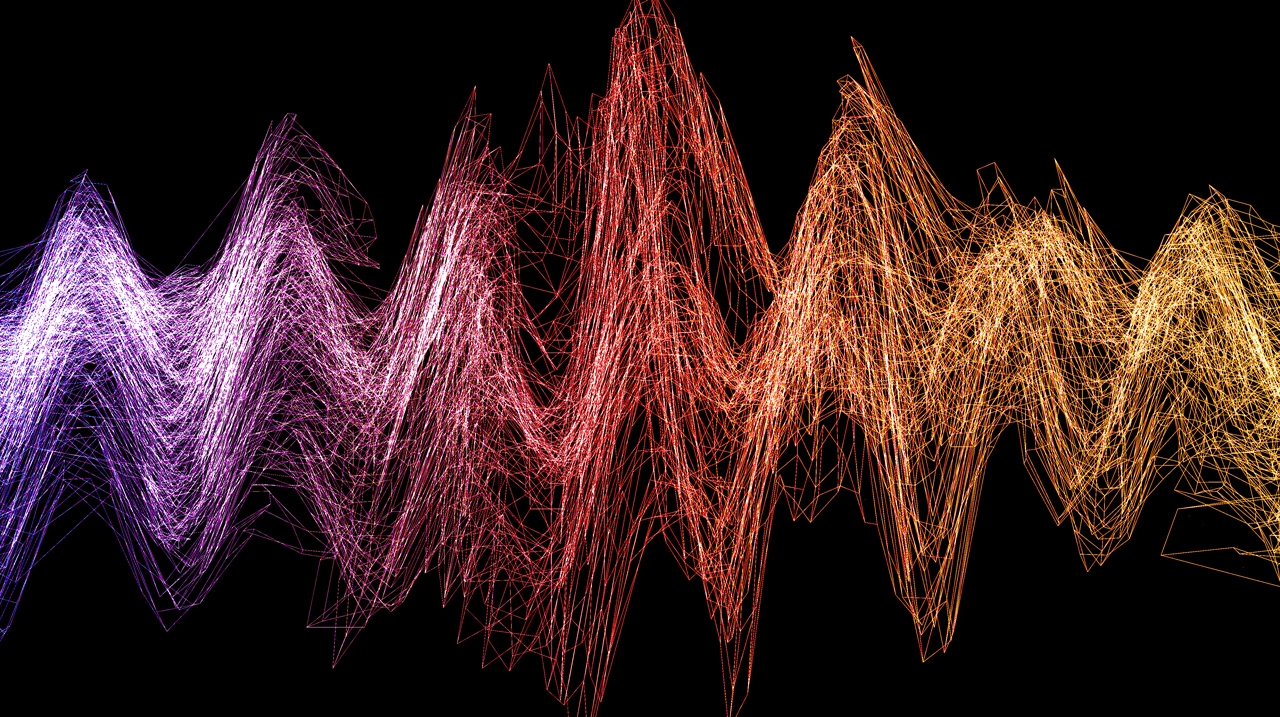
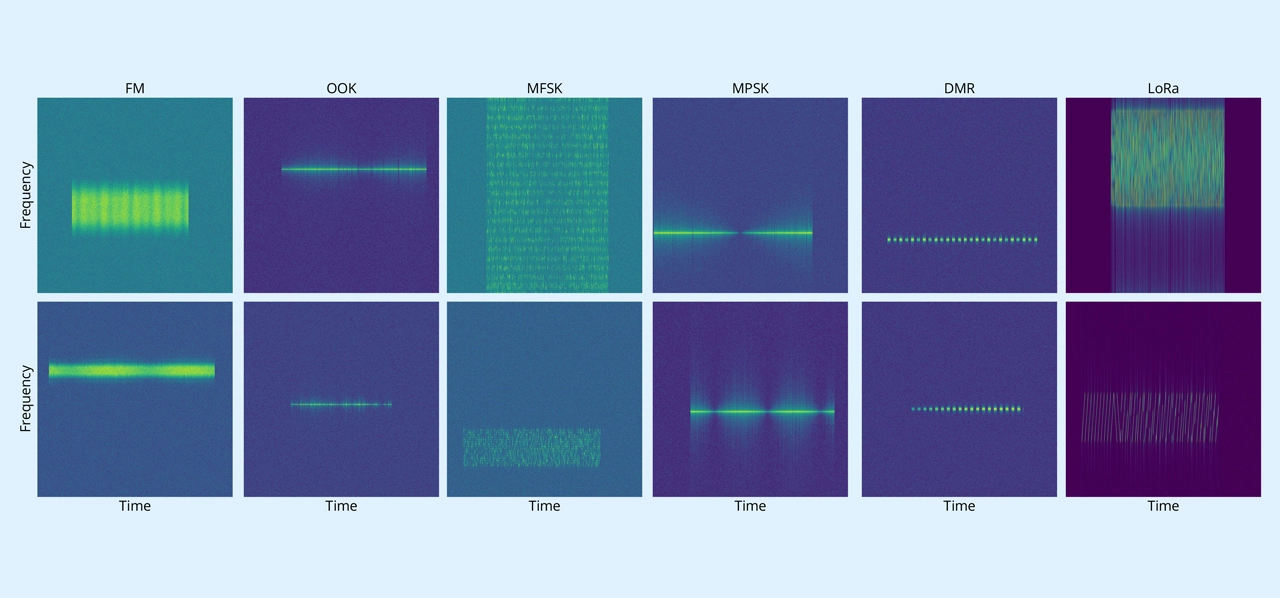
There are various possible ways in which an RF signal could be transformed into a suitable form for an AI model to process. In this project, the signal magnitude as a function of time produced by a single antenna was converted into a spectrogram. A spectrogram is a 2D representation that captures both time and frequency information.
Since a spectrogram is effectively an image, existing image-based object detection AI models (e.g. mask R-CNN) could be used as the starting point for RF classification. However, as they have not been trained to classify RF signals, it was first necessary to retrain the AI model using new data. To avoid the need to collect large quantities of real data an RF model was used to generate synthetic data of different RF signal types with varied environmental effects applied. This training set consisted of 1000 examples each of six different signal types (e.g. FM, OOK, MFSK, MPSK, DMR and LoRa) with an additional 100 examples of each for testing. This process is known as transfer learning as it allows an AI model to be initially trained for one application on a large quantity of data but then be retrained on a smaller quantity of data for a different task.
The Outcome
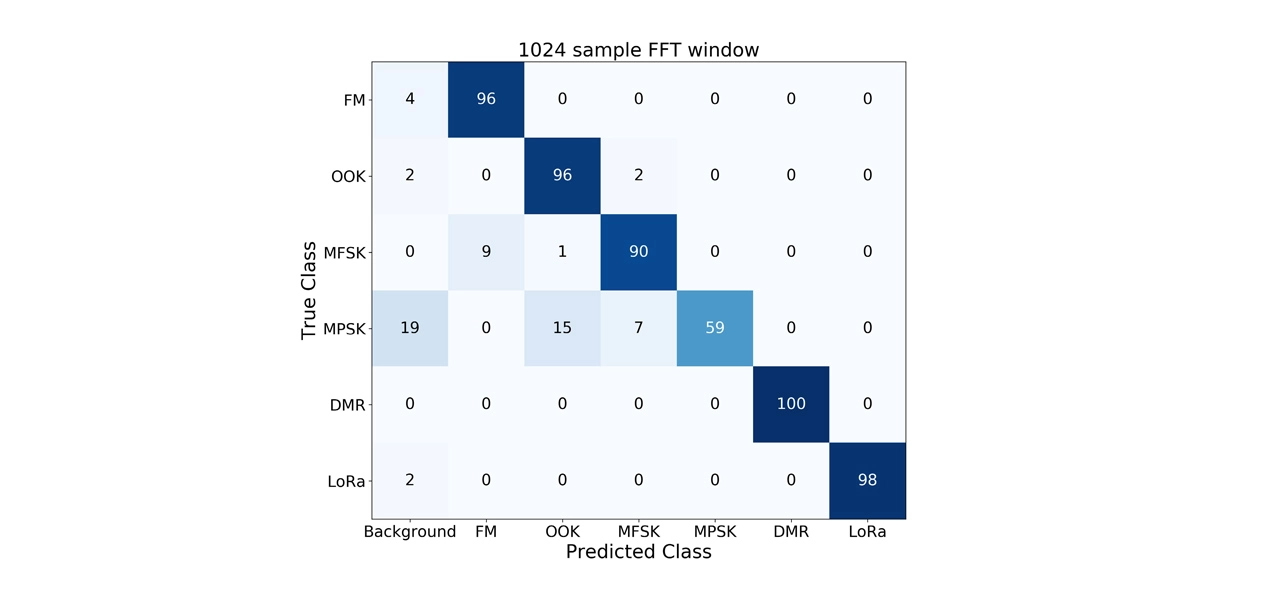
Once this AI model had been retrained to recognise RF signals it was used to process new spectrograms for detection and classification. This worked effectively on simulated data and it successfully detected and classified signals that were overlapping in time and/or frequency. The confusion matrix shows good classification performance across all signals with the exception of Multiple Phase-Shift Keying (MPSK) which, if detected, was sometimes confused with On-Off Keying (OOK) or Multiple Frequency-Shift Keying (MFSK). This was due to the occasional similarity of the signals within the analysis window and could be resolved with further development.
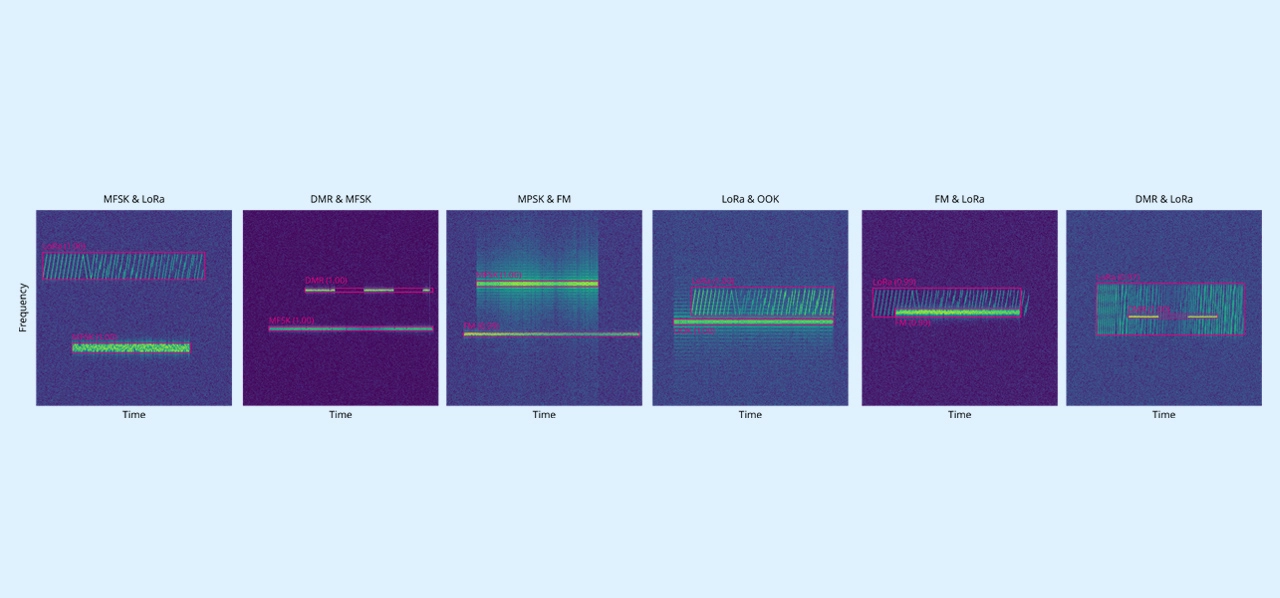
As part of the performance assessment, some measurements of real transmitters were taken and analysed. Despite no real devices being included in the training set the AI model was able to detect and classify most RF signals. Those it was not successful against looked significantly different in the spectrogram in comparison to the training data.
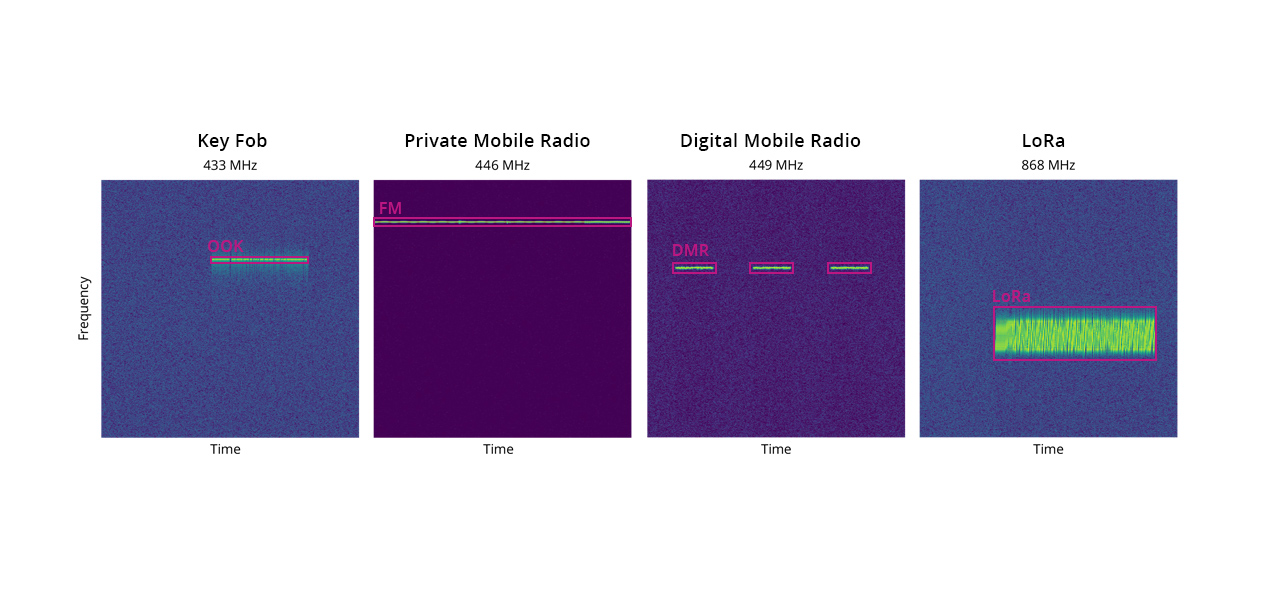
A key outcome from this work was demonstrating that retraining an AI model using synthetic data can still produce a model that can operate on real measured signals. This reduces the requirement for resource intensive real data collection to produce a training set allowing rapid retraining of a model for new applications. A more limited quantity of real data can then be used to enhance the performance in what is effectively a second transfer learning step.
“Retraining an image-based object detection AI model on synthetic RF data allows varied RF applications to be automated, though boosting the training set with some real data will ground the model to produce optimal performance.”
Dr Damien Clarke, Head of Data Science
Ready to automate RF signal classification?

Plextek develops AI-based RF signal classification systems, from algorithm development through to embedded real-time processing solutions. Our transfer learning approach enables efficient training using synthetic data whilst achieving strong real-world performance across spectrum management, ew, and communications monitoring applications.
Get in touch with us to discuss your RF signal classification requirements.
Related Technical Papers
View All
Sensing in space
Space holds vast promise. Orbiting satellites have already enabled global communications and allowed us to learn about our planet's climate. This paper will explain radar, how it works, and why it is suited to space applications. It will also discuss considerations for space companies when deploying any sensing technology. There is no one-size-fits-all when it comes to sensing. Our team works with space missions to assess if mmWave radar is right, and where it is, identify optimal configurations, software, and security to deliver against the performance and SWaP-C goals.
mmWave Imaging Radar
Camera systems are in widespread use as sensors that provide information about the surrounding environment. But this can struggle with image interpretation in complex scenarios. In contrast, mmWave radar technology offers a more straightforward view of the geometry and motion of objects, making it valuable for applications like autonomous vehicles, where radar aids in mapping surroundings and detecting obstacles. Radar’s ability to provide direct 3D location data and motion detection through Doppler effects is advantageous, though traditionally expensive and bulky. Advances in SiGe device integration are producing more compact and cost-effective radar solutions. Plextek aims to develop mm-wave radar prototypes that balance cost, size, weight, power, and real-time data processing for diverse applications, including autonomous vehicles, human-computer interfaces, transport systems, and building security.
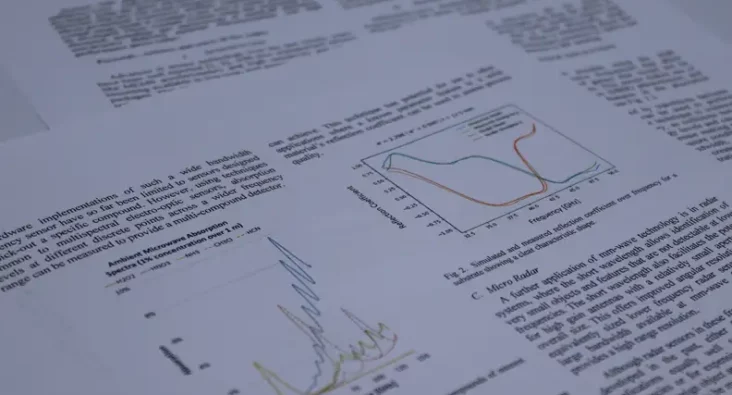
Low Cost Millimeter Wave Radio frequency Sensors
This paper presents a range of novel low-cost millimeter-wave radio-frequency sensors that have been developed using the latest advances in commercially available electronic chip-sets. The recent emergence of low-cost, single chip silicon germanium transceiver modules combined with license exempt usage bands is creating a new area in which sensors can be developed. Three example systems using this technology are discussed, including: gas spectroscopy at stand off distances, non-invasive dielectric material characterization and high performance micro radar.
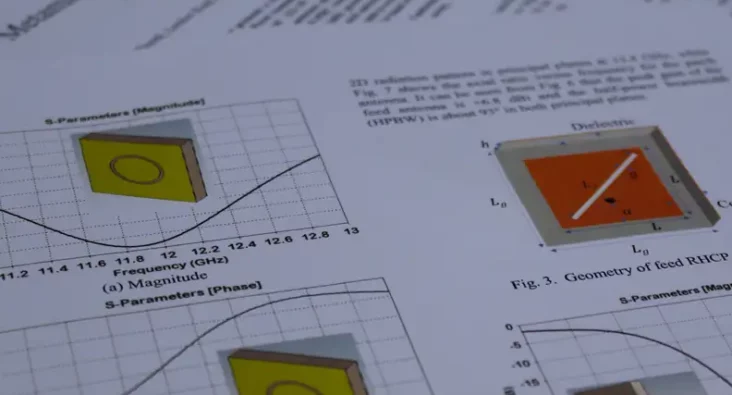
Ku-Band Metamaterial Flat-Panel Antenna for Satcom
This technical paper by Dr. Rabbani and his team presents research on metamaterial-based, high-gain, flat-panel antennas for Ku-band satellite communications. The study focuses on leveraging the unique electromagnetic properties of metamaterials to enhance the performance of flat-panel antenna designs, aiming for compact structures with high gain and efficiency. The research outlines the design methodology involving multi-layer metasurfaces and leaky-wave antennas to achieve a compact antenna system with a realised gain greater than +20 dBi and an operational bandwidth of 200 MHz. Simulations results confirm the antenna's high efficiency and performance within the specified Ku-band frequency range. Significant findings include the antenna's potential for application in low-cost satellite communication systems and its capabilities for THz spectrum operations through design modifications. The paper provides a detailed technical roadmap of the design process, supported by diagrams, simulation results, and references to prior work in the field. This paper contributes to the advancement of antenna technology and metamaterial applications in satellite communications, offering valuable insights for researchers and professionals in telecommunications.

The Kootwijk VLF Antenna: A Numerical Model
A comprehensive analysis of the historical Kootwijk VLF (Very Low Frequency, which covers 3-30 kHz) antenna, including the development of a numerical model to gain insight into its operation. The Kootwijk VLF antenna played a significant role in long-range communication during the early 20th century. The paper addresses the challenge of accurately modelling this electrically small antenna due to limited historical technical information and its complex design. The main goal is to understand if the antenna’s radiation efficiency might explain why “results were disappointing” for the Kootwijk to Malabar (Indonesia) communications link. Through simulations and comparisons with historical records, the numerical model reveals that the Kootwijk VLF antenna had a low radiation efficiency – about 8.9% – for such a long-distance link. This work discusses additional loss mechanisms in the antenna system that might not have been considered previously, including increased transmission-line losses as a result of impedance mismatch, wires having a lower effective conductivity than copper and inductor quality factors being lower than expected. The study provides insights into key antenna parameters, such as the radiation pattern, the antenna’s quality factor, half-power bandwidth and effective height, as well as the radiated power level and the power lost through dissipation. This research presents the first documented numerical analysis of the Kootwijk VLF antenna and contributes to a better understanding of its historical performance. While the focus has been at VLF, this work can aid future modelling efforts for electrically small antennas at other frequency bands.
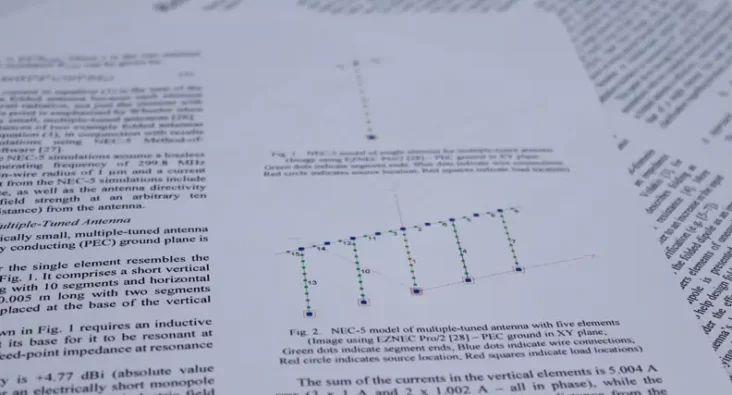
The Radiation Resistance of Folded Antennas
This technical paper highlights the ambiguity in the antenna technical literature regarding the radiation resistance of folded antennas, such as the half-wave folded dipole (or quarter-wave folded monopole), electrically small self-resonant folded antennas and multiple-tuned antennas. The feed-point impedance of a folded antenna is increased over that of a single-element antenna but does this increase equate to an increase in the antenna’s radiation resistance or does the radiation resistance remain effectively the same and the increase in feed-point impedance is due to transformer action? Through theoretical analysis and numerical simulations, this study shows that the radiation resistance of a folded antenna is effectively the same as its single-element counterpart. This technical paper serves as an important point of clarification in the field of folded antennas. It also showcases Plextek's expertise in antenna theory and technologies. Practitioners in the antenna design field will find valuable information in this paper, contributing to a deeper understanding of folded antennas.

Chilton Ionosonde Data & HF NVIS Predictions during Solar Cycle 23
This paper presents a comparison of Chilton ionosonde critical frequency measurements against vertical-incidence HF propagation predictions using ASAPS (Advanced Stand Alone Prediction System) and VOACAP (Voice of America Coverage Analysis Program). This analysis covers the time period from 1996 to 2010 (thereby covering solar cycle 23) and was carried out in the context of UK-centric near-vertical incidence skywave (NVIS) frequency predictions. Measured and predicted monthly median frequencies are compared, as are the upper and lower decile frequencies (10% and 90% respectively). The ASAPS basic MUF predictions generally agree with fxI (in lieu of fxF2) measurements, whereas those for VOACAP appear to be conservative for the Chilton ionosonde, particularly around solar maximum. Below ~4 MHz during winter nights around solar minimum, both ASAPS and VOACAP MUF predictions tend towards foF2, which is contrary to their underlying theory and requires further investigation. While VOACAP has greater errors at solar maximum, those for ASAPS increase at low or negative T-index values. Finally, VOACAP errors might be large when T-SSN exceeds ~15.
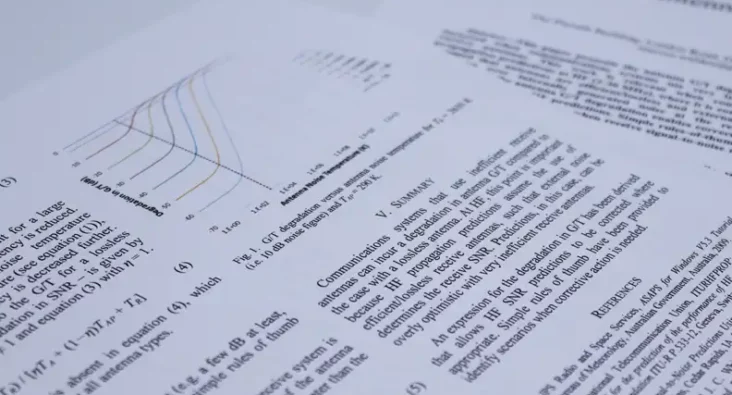
Antenna GT Degradation with Inefficient Receive Antenna at HF
This paper presents the antenna G/T degradation incurred when communications systems use very inefficient receive antennas. This work is relevant when considering propagation predictions at HF (2-30 MHz), where it is commonly assumed that antennas are efficient/lossless and external noise dominates over internally generated noise at the receiver. Knowledge of the antenna G/T degradation enables correction of potentially optimistic HF predictions. Simple rules of-thumb are provided to identify scenarios when receive signal-to-noise ratios might be degraded.
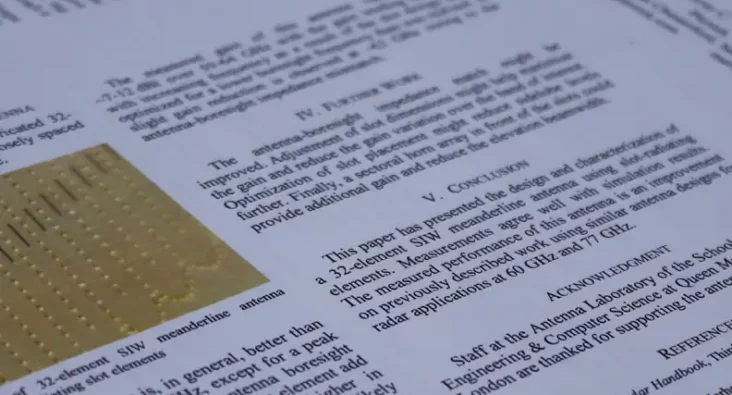
60 GHz F-Scan SIW Meanderline Antenna for Radar Applications
This paper describes the design and characterization of a frequency-scanning meanderline antenna for operation at 60 GHz. The design incorporates SIW techniques and slot radiating elements. The amplitude profile across the antenna aperture has been weighted to reduce sidelobe levels, which makes the design attractive for radar applications. Measured performance agrees with simulations, and the achieved beam profile and sidelobe levels are better than previously documented frequency-scanning designs at V and W bands.

Midlatitude 5 MHz HF NVIS Links: Predictions vs. Measurements
Signal power measurements for a UK-based network of three beacon transmitters and five receiving stations operating on 5.290 MHz were taken over a 23 month period between May 2009 and March 2011, when solar flux levels were low. The median signal levels have been compared with monthly median signal level predictions generated using VOACAP (Voice of America Coverage Analysis Program) and ASAPS (Advanced Stand Alone Prediction System) HF prediction software with the emphasis on the near-vertical incidence sky wave (NVIS) links. Low RMS differences between measurements and predictions for September, October, November, and also March were observed. However, during the spring and summer months (April to August), greater RMS differences were observed that were not well predicted by VOACAP and ASAPS and are attributed to sporadic E and, possibly, deviative absorption influences. Similarly,the measurements showed greater attenuation than was predicted for December, January, and February, consistent with the anomalously high absorption associated with the “winter anomaly.” The summer RMS differences were generally lower for VOACAP than for ASAPS. Conversely, those for ASAPS were lower during the winter for the NVIS links considered in this analysis at the recent low point of the solar cycle. It remains to be seen whether or not these trends in predicted and measured signal levels on 5.290 MHz continue to be observed through the complete solar cycle.

Electrically small monopoles: Classical vs. Self-Resonant
This paper shows that the Q-factor and VSWR of a monopole are significantly lowered when made resonant by reactive loading (as is used in practice). Comparison with a self-resonant Koch fractal monopole of equal height gives similar values of VSWR and Q-factor. Thus, the various electrically small monopoles (self-resonant and reactively loaded) offer comparable performance when ideal and lossless. However, in selecting the optimum design, conductor losses and mechanical construction at the frequency of interest must be considered. In essence, a trade-off is necessary to obtain an efficient, electrically small antenna suitable for the application in hand.

Ku-Band Low-Sidelobe Waveguide Array
The design of a 16-element waveguide array employing radiating T-junctions that operates in the Ku band is described. Amplitude weighting results in low elevation sidelobe levels, while impedance matching provides a satisfactory VSWR, that are both achieved over a wide bandwidth (15.7-17.2 GHz). Simulation and measurement results, that agree very well, are presented. The design forms part of a 16 x 40 element waveguide array that achieves high gain and narrow beamwidths for use in an electronic-scanning radar system.

Plextek Wins Place on MOD’s DDAD Framework
Plextek Selected for £180M DDAD Framework Supporting British Army's ASGARD AI Decision-Making Programme
Field Oriented Control: Precision in Modern Motor Systems
Delivering expertise in field-oriented control for demanding motor control solutions
Radar in Modern Sensing: The Power of Sensor Fusion
Radar Sensor Fusion with Cameras and Lidar: Enhanced Sensing Technology for Autonomous Systems

mmWave radar: balancing resolution and practicality in space
mmWave radar offers the ideal balance for space applications, detecting small debris and spacecraft features with minimal power and no moving parts.
Beyond policy: how industry must deliver ESA’s Zero Debris Vision
Space needs to be kept clean, and this is becoming increasingly hard as commercial and defence activities ramp up.

How radar works
How Does Radar Work? Understanding Radar Technology and Applications with Richard Jacklin

Why radar should be on your radar
Space missions demand sensors that work in brutal conditions - and radar works when everything else fails.

Accelerating the Next Generation of Electromagnetic Warfare
UK's £1 billion electromagnetic warfare investment risks failure without urgent procurement reform to match the pace of modern battlefield innovation.

Addressing the Escalation in GNSS Spoofing with Data Fusion
Plextek's data fusion technology helps maritime vessels maintain navigation accuracy during increasing GNSS spoofing attacks.

Driving Radar Innovation for Space in the CLEAR Mission
Plextek Supports ClearSpace in Completing Phase 2 of Mission CLEAR, Strengthening UK’s Leadership In Orbit Services.

Why Radar is Becoming Essential in Mission Assurance
Recent high profile reports of lunar lander failures due to loss of altitude and doppler sensing data show the necessity for a suite of sensors, making radar now essential for mission assurance.

Measuring Micro-Debris in LEO with Next-Gen Space Radar
Detecting micro-debris in real-time is key to safer space operations. Next-gen mmWave radar technology enables high-resolution tracking of even the smallest fragments in LEO, reducing collision risks and enhancing space situational awareness. Discover how this innovation supports a more sustainable orbital future.
Custom Motor Control Solution for Connected Fitness Equipment
Plextek developed a bespoke BLDC motor control solution for connected fitness equipment, delivering exceptionally low torque ripple and seamless system integration.
Read More

Overcoming Training Data Bottlenecks in Thermal Imaging with Transfer Learning
Plextek's automated transfer learning approach generates labelled thermal datasets using colour camera AI models, eliminating costly manual annotation.
Read More

Concealed object detection for real-time parcel security screening
Concealed object detection for real-time parcel security screening with mmWave sensor design and manufacture, and real-time AI processing
Read More

Enhancing network efficiency with ML & RL
Enhancing Mobile Ad-Hoc Network Routing with GNN-Driven DRL Agent: Improving Packet Delivery and Adaptability in Dynamic Environments
Read More

Optimising Radar Training with Machine-Assisted Machine Learning
See how Plextek is optimising radar training using automating data labelling & machine-assisted machine learning
Read More

Semantic Segmentation in Visual Scene Matching
Learn how we boost accuracy in Visual Scene Matching with Semantic Segmentation, aiding navigation and tracking in dynamic environments.
Read More

Harsh Environment Inductive Coupling Solutions for Emerson
Discover how our technical expertise in inductive coupling facilitated Emerson in setting industry benchmarks for efficiency and reliability in harsh environments.
Read More

Machine Learning for Rapid Propagation Assessment
Developing a groundbreaking ML model for swift and efficient coverage prediction in complex urban environments, enabling rapid optimisation of transmitter locations on standard computing hardware.
Read More
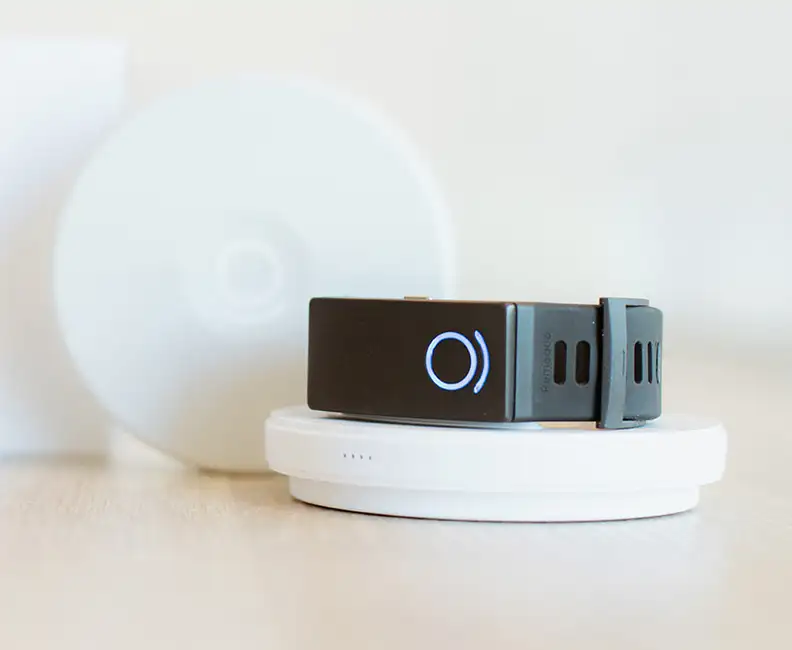
Cost-Effective Improvement in mmWave Intensity
Enhancing the mmWave antenna design for Remedee Labs, significantly boosting RF radiation efficiency and cost-effectiveness in non-pharmaceutical chronic pain treatment.
Read More

Game-Changing Radar for the CLEAR Mission
Developing vital radar technology for the CLEAR mission, advancing space debris removal techniques to safeguard operational satellites and spacecraft.
Read More
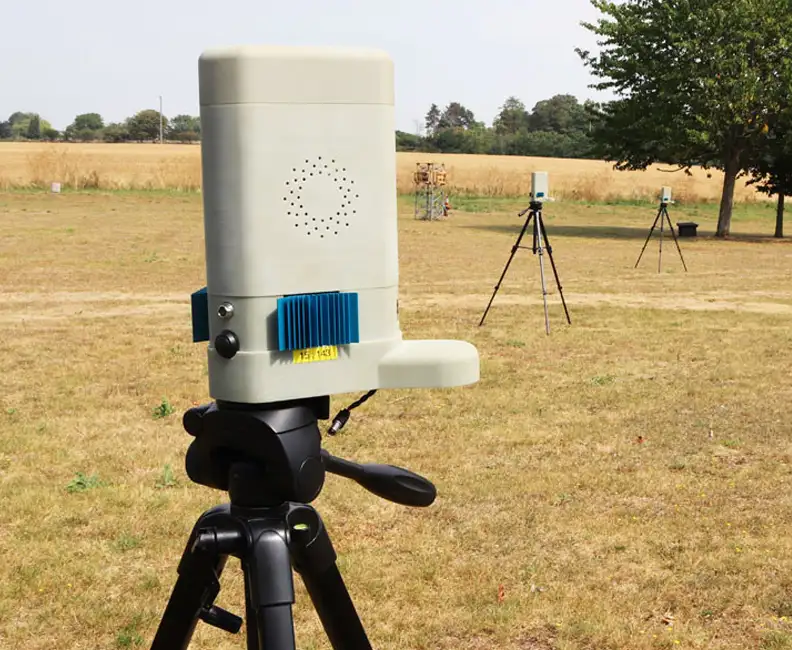
Future Sensing: Improving Mobile Ad-hoc Networks
Leading a transformative four-year research initiative to improve mobile ad-hoc networks through advanced directional antenna systems and cross-layer processing, significantly enhancing military communication capabilities.
Read More
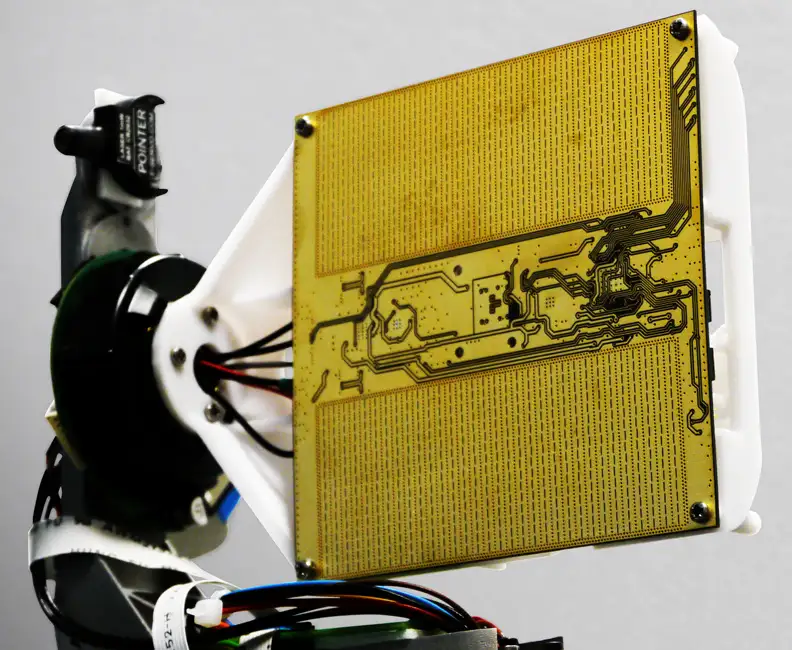
Millimetre-Wave Radar System
Expertly engineering a compact, high-performance 60 GHz millimetre-wave radar system using innovative Substrate Integrated Waveguide technology, achieving significant advancements in target detection up to 100 metres.
Read More