Integrated Sensing and Communication for FMCW Radar
Project Details
Award Won

Applications


The Challenge
Radar and communication systems have traditionally operated as separate, independent functions – each requiring its own antenna, RF chain, and processing hardware. On platforms where size, weight, power, and cost are constrained, such as drones, autonomous vehicles and portable defence systems, duplicating this hardware is not always practical. It also places increasing pressure on an already congested electromagnetic spectrum.
The growing demand for connected and intelligent systems means that many platforms now need both sensing and data transmission. Drones need to detect obstacles while receiving navigation commands. Vehicles need to track what is ahead while sharing safety data with the road around them. The question is whether both functions can be combined into a single system, without degrading the performance of either.
- Could a Frequency Modulated Continuous Wave (FMCW) radar transmit data and perform sensing simultaneously, with no compromise to its primary function?
Our Approach
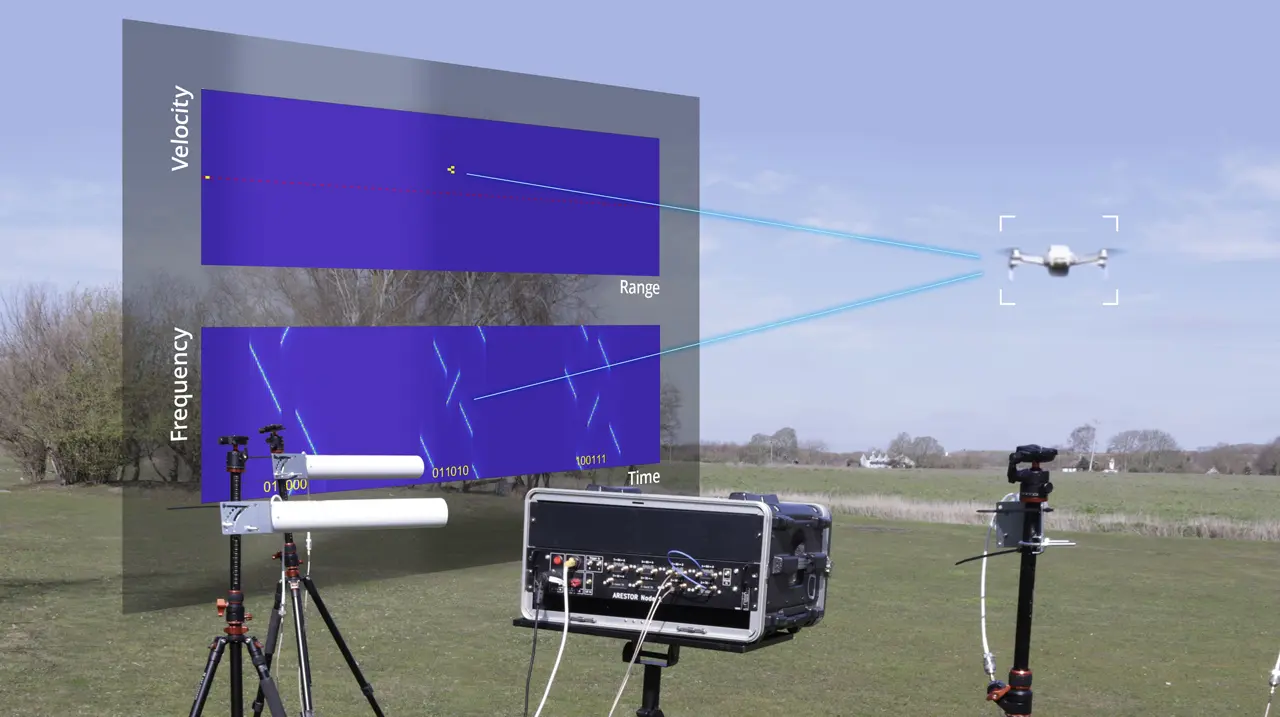
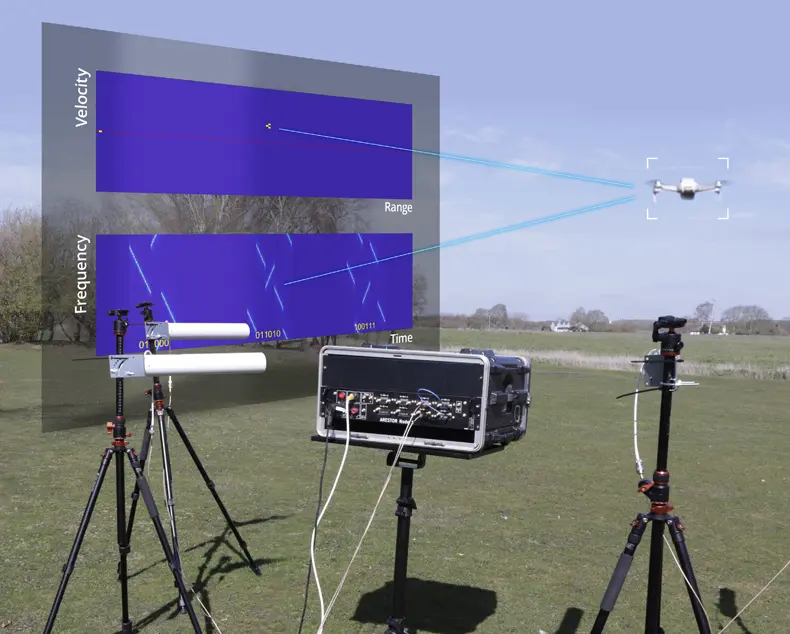
Working in collaboration with University College London (UCL), Plextek developed a novel technique that embeds communication data directly into standard FMCW radar waveforms using frequency hopping, with minimal impact on.
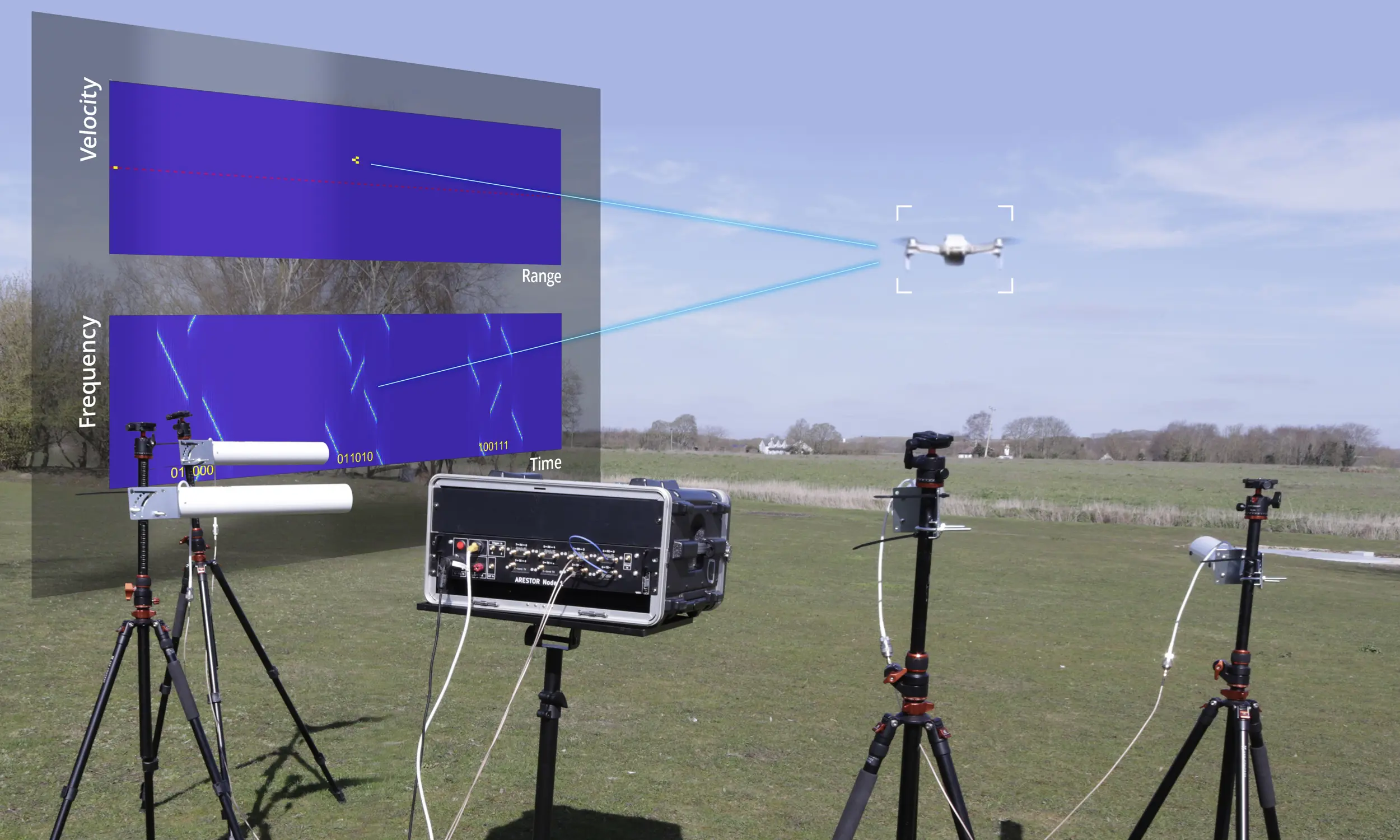
The core innovation lies in what we call the “chirplet” method. A conventional FMCW chirp sweeps continuously across a band of frequencies. Our approach breaks that chirp into discrete sub-band sections – chirplets – and reorders them to encode data. By restricting the hopping so that every frequency band is covered exactly once per chirplet, the full radar bandwidth is preserved. On the receive side, a simple reordering of the in-phase and quadrature (IQ) samples recovers the complete sensing information, allowing the use of conventional FMCW processing with standard Fast Fourier Transforms (FFTs).
This is the key distinction from other frequency-hopped Integrated Sensing and Communication (ISAC) approaches, which require computationally expensive 2D matched filters to recover the radar data. Those methods demand significantly more processing power, making them difficult to implement in real-time systems. Our technique avoids this entirely, adding only minimal computational overhead above what a standard FMCW radar already requires.
The waveform architecture also shares characteristics with LoRa communication signals, giving it a similarly high tolerance for noise, which is an important advantage in congested electromagnetic environments.
How we built an FMCW radar that senses and communicates simultaneously
The Outcome
We developed a real-time prototype demonstrating simultaneous radar sensing and data communication from a single antenna and RF chain. The technique was validated through simulation and over-the-air experimentation, including tracking a moving person in real time. Further scenarios involving vehicles, drones, and other targets have been validated through modelling and feasibility studies.
The system achieved data rates of several megabits per second while maintaining radar performance. At typical operating parameters, the energy loss introduced by the chirplet technique was negligible – at a fraction of a percent at short ranges – confirming that sensing quality is preserved. The technique was also validated against real-world targets, producing clean Range-Doppler surfaces functionally equivalent to conventional FMCW radar outputs.
This work has significant implications across multiple sectors. In defence, a single ISAC system could simultaneously track hostile drones while sending navigation commands to friendly assets, eliminating the latency that comes from switching between separate radar and communications systems. Positioning, navigation and timing (PNT) nodes could broadcast positioning signals while performing radar surveillance. In civilian applications, automotive radar systems could detect obstacles ahead while exchanging safety data with nearby vehicles, and future 5G/6G infrastructure could combine sensing capability with communications as spectrum becomes more contested.
A journal paper detailing the technique has been accepted by IEEE. This work was carried out in collaboration with UCL and supported by Innovate UK.
- In 2026, this project was recognised with the Technology Company of the Year award at the Cambridge Independent Science and Technology Awards.
The minimal additional processing required above that of a conventional FMCW radar provides clear benefits over other ISAC techniques with more complicated processing. This technique has a clear route to real-time implementation and commercialisation.
Robert Winter
Lead Researcher

Ready to integrate sensing and communication?
Winning the Invisible War: The Rise of Electronic Warfare
Forces must train to operate, fight, and command when the spectrum is contested.

Passive Radar for Detecting Aircraft Without Emitting
Passive radar aircraft detection without signal emission; solving direct path interference for silent, persistent air surveillance.
International Patent Grants for Pain Management Technology
Plextek engineers named as co-inventors on newly granted patents underpinning the first clinically validated, non-pharmaceutical wristband for chronic pain management
How Do You Radiation-Test a Complex IC?
Rigorous radiation characterisation is what makes the difference between a reliable device and one that fails unpredictably

Plextek Receives a King’s Award for Enterprise for Innovation 2026
Plextek has been honoured with a King's Award for Enterprise for Innovation

Why the Best RF Design Removes the Problem Entirely
Vlad Lenive, Lead RF Systems Engineer, brings 30 years of experience from Skynet 5 to sub-THz arrays. He talks HAPS, low-SWaP design, and why the best RF architectures eliminate components rather than shrink them.

The importance of GNSS Resilience in Modern Warfare
A single day of GNSS disruption could cost the UK economy over £1.4 billion. As jamming and spoofing become tools of hybrid warfare, layered PNT resilience is no longer optional.

Seeing Clearly in Orbit: The Turning Point for Space Radar
Richard Jacklin explores why 2026 is a turning point for compact radar in space, covering SAR, debris detection, 6G NTN communications and the UK skills gap.

Plextek Wins Place on MOD’s DDAD Framework
Plextek Selected for £180M DDAD Framework Supporting British Army's ASGARD AI Decision-Making Programme
Field Oriented Control: Precision in Modern Motor Systems
Delivering expertise in field-oriented control for demanding motor control solutions
Radar in Modern Sensing: The Power of Sensor Fusion
Radar Sensor Fusion with Cameras and Lidar: Enhanced Sensing Technology for Autonomous Systems
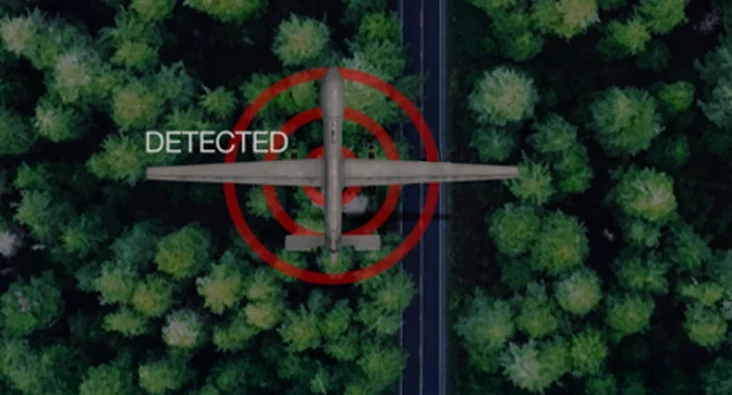
Accelerating the Next Generation of Electromagnetic Warfare
UK's £1 billion electromagnetic warfare investment risks failure without urgent procurement reform to match the pace of modern battlefield innovation.
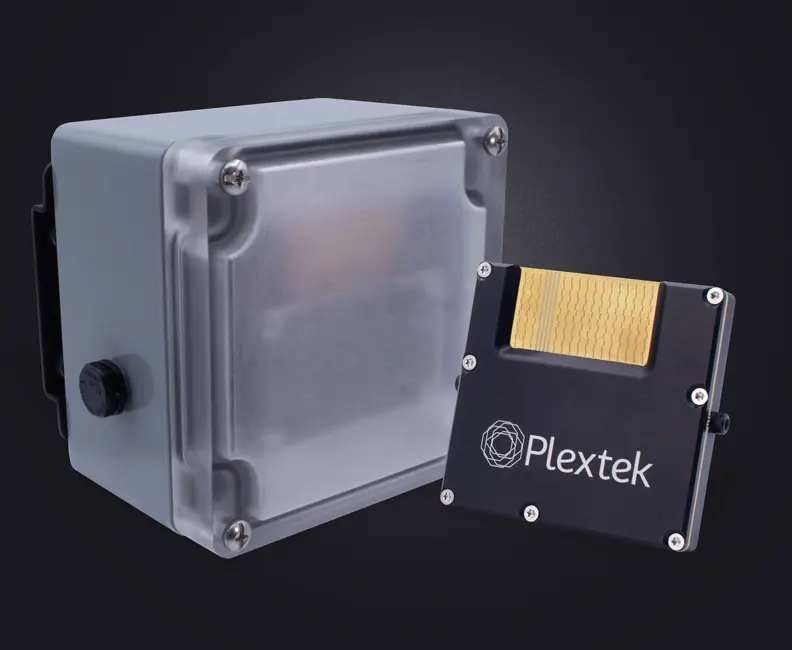
Autonomous Radar Networks for Critical Infrastructure Security
Our mmWave radar sensors integrated with AI-driven command and control to deliver autonomous, cost-effective security monitoring for UK nuclear decommissioning sites.
Read More
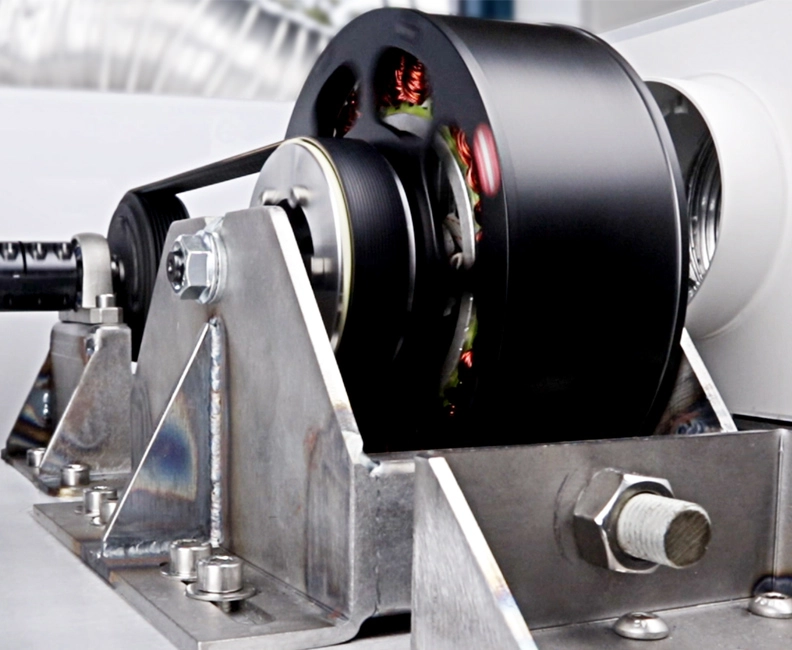
Custom Motor Control Solution for Connected Fitness Equipment
Plextek developed a bespoke BLDC motor control solution for connected fitness equipment, delivering exceptionally low torque ripple and seamless system integration.
Read More

Overcoming Training Data Bottlenecks in Thermal Imaging with Transfer Learning
Plextek's automated transfer learning approach generates labelled thermal datasets using colour camera AI models, eliminating costly manual annotation.
Read More
Using AI to Detect and Classify RF Signals in a Congested Environment
Developing AI-based RF signal classification systems, from algorithm development through to embedded real-time processing solutions
Read More

Concealed object detection for real-time parcel security screening
Concealed object detection for real-time parcel security screening with mmWave sensor design and manufacture, and real-time AI processing
Read More
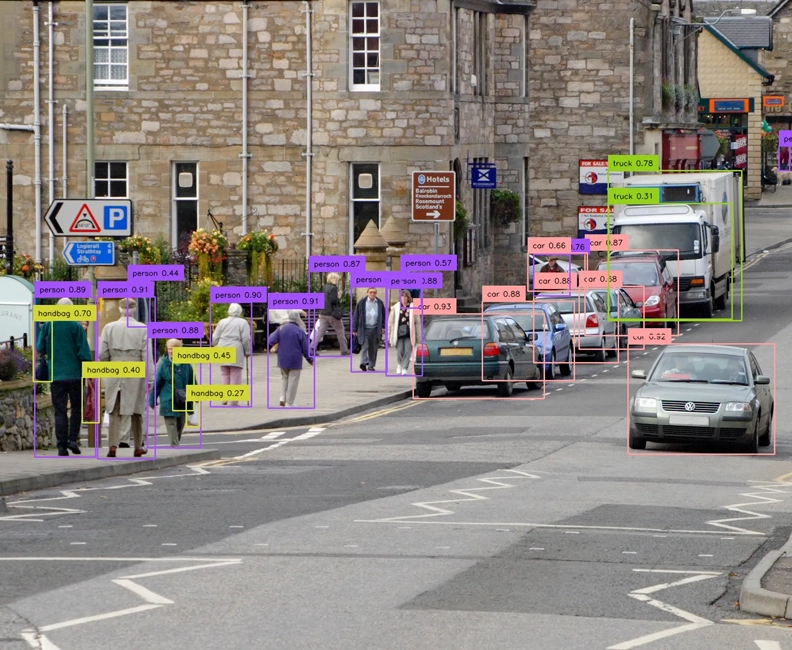
Optimising Radar Training with Machine-Assisted Machine Learning
See how Plextek is optimising radar training using automating data labelling & machine-assisted machine learning
Read More
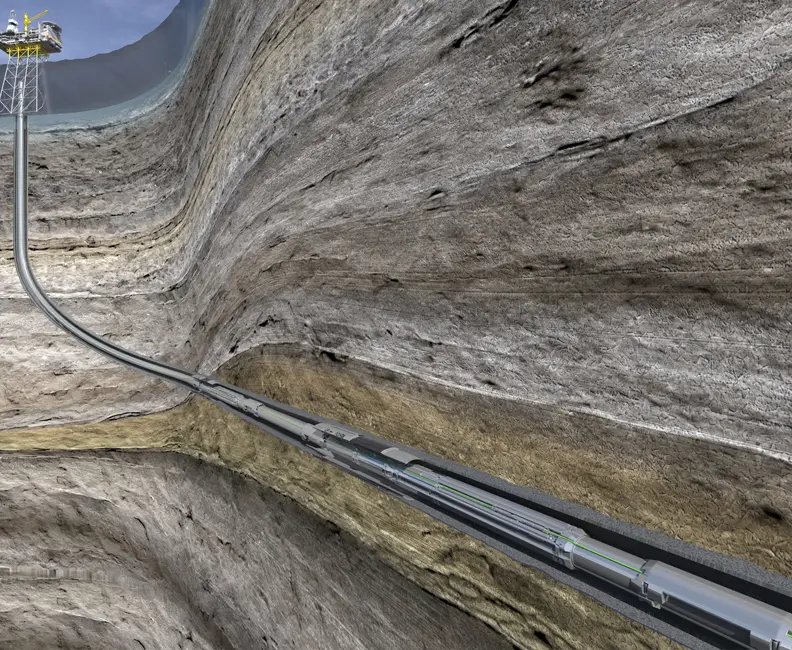
Harsh Environment Inductive Coupling Solutions for Emerson
Discover how our technical expertise in inductive coupling facilitated Emerson in setting industry benchmarks for efficiency and reliability in harsh environments.
Read More
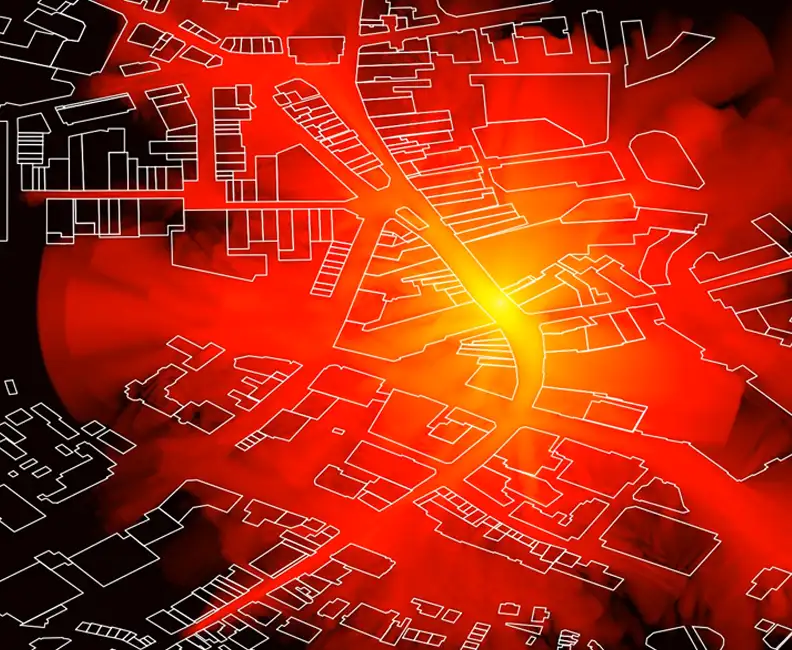
Machine Learning for Rapid Propagation Assessment
Developing a groundbreaking ML model for swift and efficient coverage prediction in complex urban environments, enabling rapid optimisation of transmitter locations on standard computing hardware.
Read More
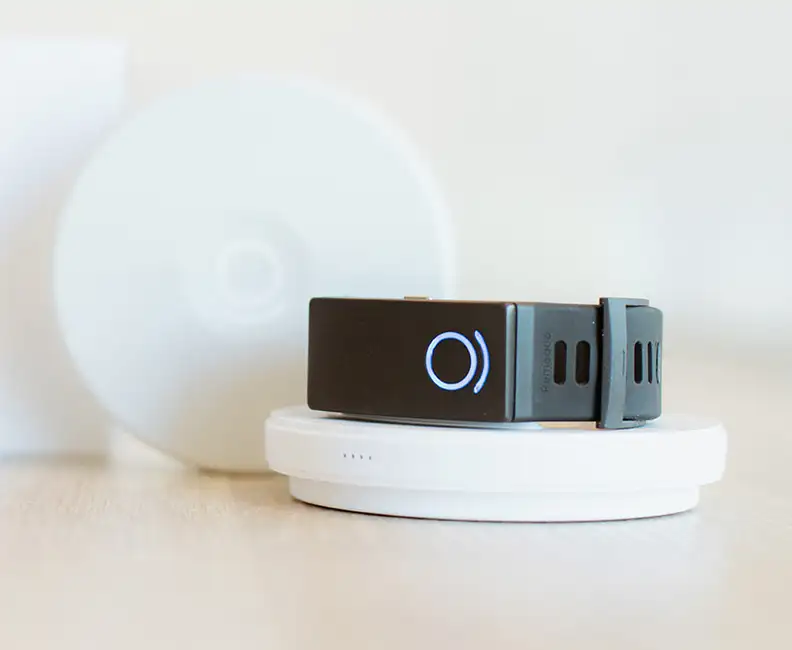
Cost-Effective Improvement in mmWave Intensity
Enhancing the mmWave antenna design for Remedee Labs, significantly boosting RF radiation efficiency and cost-effectiveness in non-pharmaceutical chronic pain treatment.
Read More

Game-Changing Radar for the CLEAR Mission
Developing vital radar technology for the CLEAR mission, advancing space debris removal techniques to safeguard operational satellites and spacecraft.
Read More
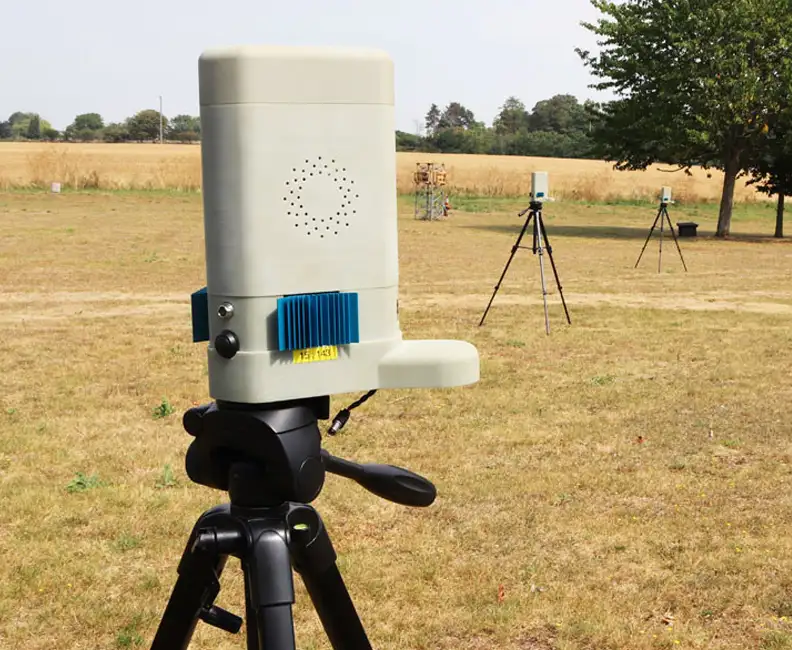
Future Sensing: Improving Mobile Ad-hoc Networks
Leading a transformative four-year research initiative to improve mobile ad-hoc networks through advanced directional antenna systems and cross-layer processing, significantly enhancing military communication capabilities.
Read More
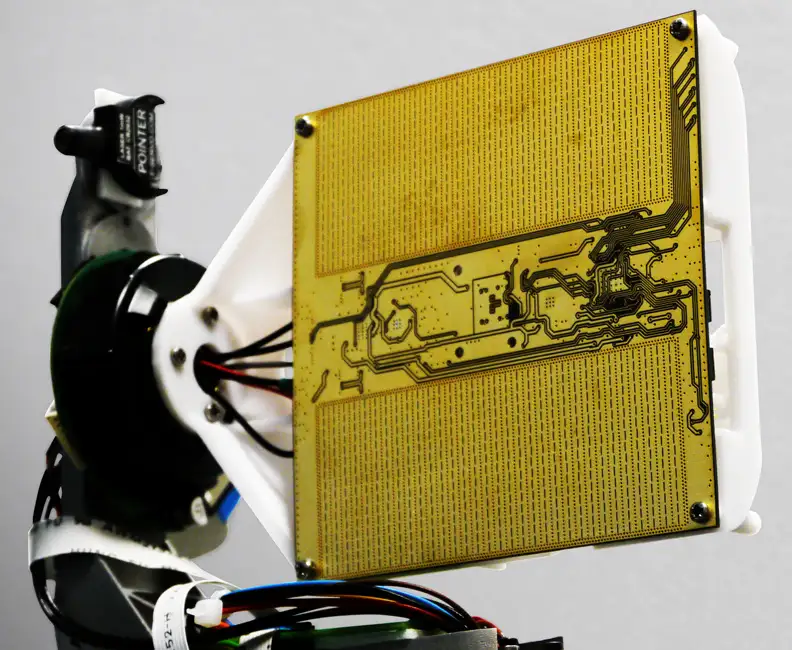
Millimetre-Wave Radar System
Expertly engineering a compact, high-performance 60 GHz millimetre-wave radar system using innovative Substrate Integrated Waveguide technology, achieving significant advancements in target detection up to 100 metres.
Read More